Tag: best practices

  • Email Marketing is Still King

    Email Marketing is Still King

    Why Email Marketing Is Still the King of Conversions Heading into 2026

    Every couple of years, someone comes along to declare email is dead. The headlines pop up like clockwork: “Email is Over,” “No One Reads Emails Anymore,” or “Social Media Has Replaced Email.”

    But here we are, stepping into 2026, and email is still the number one conversion tool in digital marketing. In fact, it’s stronger than ever.

    The truth is, email isn’t going anywhere. People may scroll past ads, algorithms may hide your posts, SEO may take months to gain traction — but email lands directly in the inbox. It’s personal, measurable, and built to drive action. For businesses serious about generating leads and conversions, email remains the backbone of a strong digital strategy.

    At ShiverMedia, we’ve been in the email game for over 20 years. We’ve run campaigns for dating apps, fitness brands, travel companies, and entertainment projects. We’ve seen the shift from basic text newsletters to hyper-personalized, AI-powered, data-driven campaigns. And after two decades, we can say this with confidence: email is not dead — it’s the best tool you have for conversions in 2026.
    email is always king

    Why People Still Think Email Is Dead

    So why do people keep writing obituaries for email marketing?

    1. Shiny New Toys Every new platform — from TikTok to Threads to whatever comes next — creates the illusion that older channels are irrelevant. But trends come and go. Email stays.
    2. Overcrowded Inboxes Yes, people get a lot of email. But they still read the ones that matter. The average professional checks their email around 15 times a day.
    3. Poor Campaigns Marketers who blast irrelevant, spammy content see weak results and assume email doesn’t work. The truth is, bad email doesn’t work. Good email still crushes it.
    4. Spam Confusion Many people confuse spam with real marketing. Spam is junk. Real email marketing is permission-based, relevant, and adds value.

    When you look at the actual numbers, email tells a different story. The industry average ROI continues to sit around $36 for every $1 spent. Social media ad costs are rising, SEO takes months to generate returns, but email delivers results you can measure instantly.


    True Email vs. Spam: The Big Difference

    It’s worth underlining this point: true email marketing is not spam.

    • True Email Marketing is personalized, relevant, and permission-based. People opt in because they want your content. The emails are tailored to their interests, behaviors, or past purchases. They respect boundaries and create trust.
    • Spam is generic, intrusive, and often sent without consent. It’s the digital equivalent of junk mail. It doesn’t care who’s on the other end.

    We’ve seen this difference play out in real campaigns.

    For a dating app client, instead of blasting the same message to everyone, we created behavior-based triggers. If someone hadn’t logged in for two weeks, they got a gentle nudge. If someone had just joined, they got a welcome sequence guiding them through features. The results? Engagement rates soared. Spam doesn’t do that. Real email marketing does.


    Why Email Outperforms Social and SEO
    Social media and SEO have their place, but when it comes to conversions, email leaves them behind.

    Direct Access

    On social, algorithms decide who sees your content. On search, you’re fighting for visibility against millions of results. Email goes straight to the inbox. If they opted in, you’re in.

    Built for Action

    People scroll social feeds for entertainment. They use Google to research. But when they open their inbox, they’re primed for action. Email is designed for CTAs — click, buy, register, download.

    ROI That Beats Everything Else

    $36 for every $1 spent. No other channel consistently comes close.

    Data You Can Use

    Email marketing provides granular insights: open rates, click-throughs, conversions, even heat maps showing what parts of your message get attention. Social and SEO can’t compete with that level of clarity.

    Ownership

    You don’t own your social followers. The platform does. Your SEO rankings can vanish with the next Google update. Your email list? That’s yours. It’s an asset no one can take away.


    ESPs Powering Email Marketing in 2026

    The tools available today are smarter and more powerful than ever. They’re no longer just about sending newsletters. They’re about creating automated, personalized, AI-driven experiences. Here’s a look at the ESPs shaping 2026:

    MailerLite

    Affordable, intuitive, and powerful. MailerLite has become a go-to for small businesses, creators, and startups. It offers easy drag-and-drop design, strong automation, and solid deliverability at a fraction of the cost of some bigger platforms. For businesses just starting out — or those who want clean, no-frills power — MailerLite is a serious contender.

    Klaviyo

    The gold standard for e-commerce. Its predictive analytics and Shopify integration make it a powerhouse for online stores. Perfect if you need to send abandoned cart reminders, product recommendations, or seasonal promos.

    Mailchimp

    Still a major player, especially for small to midsize businesses. Easy-to-use templates, AI-assisted tools, and solid automation workflows.

    HubSpot

    For businesses that need CRM + email in one ecosystem, HubSpot delivers. Its ability to tie marketing, sales, and service together makes it ideal for complex buyer journeys.

    ActiveCampaign

    Great for service-based businesses or B2B brands that need robust automation and CRM features. Excellent for long, relationship-driven funnels.

    Litmus & Stripo

    Design and testing tools that ensure your emails look good everywhere. With more users opening on mobile and dark mode, testing is critical.

    Phrasee & AI Tools

    AI tools like Phrasee are rewriting subject lines and optimizing content tone to boost engagement. As AI evolves, expect ESPs to roll these features directly into their platforms.


    How to Choose the Right ESP

    Not every ESP is a fit for every business. Ask yourself:

    • Can it scale with your list growth?
    • Does it support the workflows you need (abandoned cart, re-engagement, onboarding)?
    • Does it integrate with your e-commerce platform, CRM, or booking system?
    • Are analytics strong enough to prove ROI?
    • Does it support compliance (GDPR, CCPA, CASL)?

    At ShiverMedia, we’ve guided clients through these choices. For fitness brands, automation and scheduling are top priorities. For travel companies, segmentation rules the day. For startups, affordability and ease of use matter most. The “best” ESP is the one that supports your business model and growth stage.


    ShiverMedia’s 20-Year Email Journey
    We’ve been at this since the early 2000s, when email meant clunky HTML and mass newsletters. Back then, personalization meant adding “Hi [First Name].”

    Fast-forward 20 years, and the landscape is unrecognizable. Automation, segmentation, AI-driven content, and predictive analytics have changed the game.

    • Dating Apps: We built onboarding flows, re-engagement campaigns, and premium upsell funnels. These improved retention and boosted subscriptions.
    • Travel Companies: We segmented audiences into families, couples, and adventure travelers. Bookings rose by 30% in three months.
    • Fitness Brands: We automated reminders, motivational content, and upsell offers. Churn dropped, memberships grew.
    • Entertainment Projects: From event reminders to episodic promos, emails consistently drove ticket sales and engagement.

    The lesson? No matter the industry, email delivers when you respect the audience and build a strategy that serves them.


    Best Practices for Email in 2026

    1. Segmentation Is Essential

    Generic blasts don’t work. Group your audience by interest, behavior, or stage in the funnel.

    2. Smarter Automation

    From welcome series to re-engagement flows, automation saves time and nurtures leads around the clock.

    3. Mobile-First Design

    Over 60% of emails are opened on mobile. If it doesn’t look good on a phone, it doesn’t work.

    4. Privacy and Compliance

    With GDPR, CCPA, and likely new regulations ahead, compliance isn’t optional. Always get opt-in consent and make unsubscribing easy.

    5. Testing and Optimization

    Subject lines, send times, layouts — test everything. Even small improvements stack into major ROI.

    6. Value Over Volume

    Don’t send more emails. Send better ones. Each email should have a reason to exist and deliver value.


    Case Studies by Industry

    Travel

    A boutique travel company segmented customers by type of traveler. Families got different content than solo adventurers. The result? Open rates up 40%, conversions up 30%.

    Dating Apps

    Behavioral triggers sent nudges to inactive users, improving retention by 25%.

    Fitness

    Automated reminders and motivational content reduced churn by 15% and increased premium upgrades.


    Trends Defining 2026
    • AI Personalization – Real-time, hyper-personalized recommendations.
    • Interactive Emails – Carousels, surveys, and even purchases without leaving the inbox.
    • Dark Mode Design – Essential as more users adopt it.
    • Sustainability Messaging – Consumers expect eco-conscious communication.
    • Compliance First – Stricter privacy laws are coming. Transparency and trust will separate winners from losers.

    Why Email Still Matters

    At the end of the day, email isn’t just about sending promotions. It’s about building relationships, creating conversations, and driving measurable results.

    We’ve seen email evolve for 20 years at ShiverMedia. The platforms, tools, and designs may change, but the fundamentals remain the same: email works.

    Heading into 2026, the brands that succeed will be those who treat email as more than a broadcast tool. It’s a conversation starter, a trust-builder, and still the most reliable way to turn prospects into customers.

    The inbox is where conversions happen. And in 2026, it still matters more than ever.

    If you want to get an email audit to see how your email marketing stacks up to your competitors and best practices, email us.
  • 5 Best Onboarding Email Practices

    5 Best Onboarding Email Practices

    Building Relationships and Driving Conversions

    In the digital age, onboarding emails are one of the most powerful tools a business can use to establish relationships with new subscribers and guide them through their customer journey. These emails provide a structured introduction to your brand while laying the foundation for trust, engagement, and conversions.

    At Shiver Media, we’ve seen firsthand how a well-thought-out onboarding strategy can make or break the first impression. By welcoming new subscribers with tailored messaging and clear value, businesses can transform curious prospects into loyal customers. Let’s dive deeper into what makes a stellar onboarding email sequence, along with examples from projects we’ve crafted for clients across industries.

    customer relationships

    Why Onboarding Emails Matter

    Before we jump into best practices, it’s worth emphasizing why onboarding emails are so impactful. These emails serve as the first touchpoint after a subscriber opts into your list. Beyond welcoming them, they also:

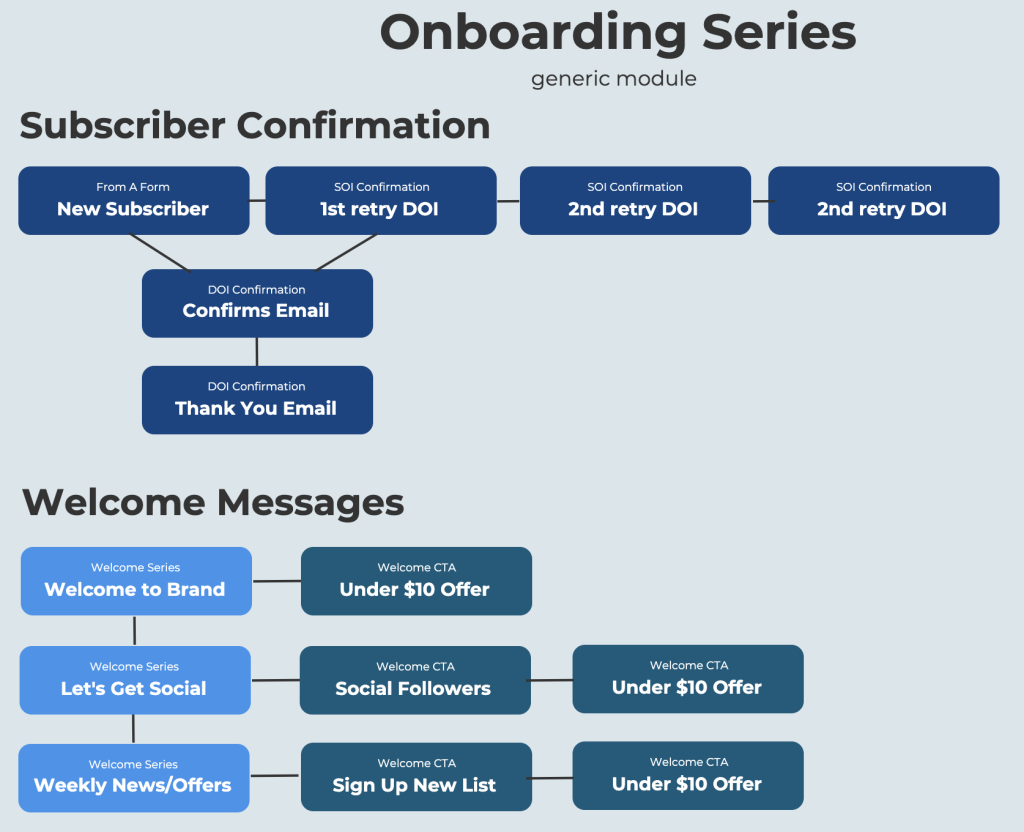
    • Confirm interest through a double opt-in process.
    • Set expectations about future communications.
    • Establish credibility and authority.
    • Nurture leads toward purchasing decisions.

    The double opt-in is particularly crucial. It ensures your subscribers are genuinely interested and helps keep your email list clean, protecting your domain’s reputation and improving deliverability rates. Your first email should include a warm welcome and a request for confirmation. Once confirmed, you can start engaging with meaningful, targeted content.

    When consulting or coaching, we emphasize balancing authenticity with strategic goals, a formula that’s worked across industries like e-commerce, coaching, and hospitality. By segmenting audiences and tailoring the messaging, our clients have seen substantial growth in both engagement and revenue.


    1. The Welcome Sequence: Setting the Stage for Success

    The first email your subscribers receive is the gateway to their journey with your brand. A well-designed Welcome Sequence ensures that their first impression is impactful, informative, and engaging.

    Why It Matters

    Your subscribers are at their most interested and curious right after signing up. The Welcome Sequence capitalizes on this moment by introducing your brand, highlighting the benefits of staying connected, and setting expectations for future emails.

    Welcome sign on a table in a lobby with a bright room in the background

    Crafting an Effective Welcome Sequence

    • Double Opt-In Confirmation: Ensure compliance with regulations like GDPR, CASL and CAN SPAM while filtering out invalid or uninterested subscribers. A double opt-in email confirms their subscription and adds an additional layer of trust.
    • Warm Introduction: The first email should welcome them warmly, thank them for subscribing, and provide a glimpse into what they can expect from your content or services.
    • Showcase Your Brand’s Value: Highlight your unique selling points. Whether it’s a free resource, an exclusive offer, or a link to valuable content, make it clear why they’ve made the right choice in subscribing.
    • Encourage Interaction: Include links to your most popular blog posts, social channels, or tutorials, encouraging them to explore and engage further.

    Real-Life Example: ShiverMedia’s Approach

    We’ve created Welcome Sequences for numerous clients, tailoring each to their audience. For one client, we started with a friendly “Thanks for Joining!” email, which included a special discount code, followed by a second email introducing the brand’s story and values. The result? A 40% increase in first-week engagement.

    1. Start with a Clear Strategy

    The foundation of any successful onboarding series is a well-defined strategy. These emails should be more than just a polite hello—they should introduce your brand, build trust, and move subscribers closer to taking action.

    Key Elements of a Welcome Strategy

    • Set the Tone: Ensure your brand voice shines through. Whether it’s playful, professional, or heartfelt, your tone sets the stage for future interactions.
    • Build Momentum: Keep subscribers engaged with a logical progression from one email to the next.
    • Drive Action: Every email should have a clear call to action (CTA), whether that’s to explore your website, download a guide, or make a purchase.

    Pro Tip: A strong first email introduces your brand’s story, encourages interaction, and creates excitement. The first email should spark curiosity—it’s the handshake that begins the relationship.

    2. Confirm Interest and Deliver Value

    How to Deliver Value

    • Educational Content: Share a guide or tutorial relevant to your audience.
    • Promotional Offers: Provide a discount code or a free trial to encourage purchases.
    • Supportive Resources: Link to FAQs or how-to videos.

    For example, one of our clients in the hospitality industry saw a 25% boost in bookings after incorporating personalized travel tips and local guides into their onboarding emails.


    3. Tell Your Story

    Storytelling is an underrated yet powerful tool in onboarding emails. It’s an opportunity to showcase your authenticity and connect with your audience on a deeper level.

    Crafting a Story Sequence

    Our approach to storytelling often involves a “low point to breakthrough” narrative:

    • The Challenge: Share a relatable struggle that resonates with your audience.
    • The Epiphany: Highlight the turning point that led to your brand’s creation or success.
    • The Resolution: Demonstrate how you or your products/services solved the problem.

    One standout example is a coaching client we worked with who shared their journey from burnout to balance. The story resonated with subscribers, leading to a 35% increase in course sign-ups.

    Pro Tip: End your story sequence with a cliffhanger, inviting subscribers to look out for the next email. For instance, tease an exclusive offer or resource they won’t want to miss.


    4. Introduce the First Purchase Offer

    Timing is everything when it comes to introducing your first pitch. After nurturing your subscriber through the first few emails, it’s time to present an offer they can’t refuse.

    How to Make the Pitch

    • Soft Approach: Frame the offer as a thank-you for joining your community.
    • Hard Approach: Use urgency and scarcity, such as “Limited-time offer—expires in 48 hours!”
    • Social Proof: Incorporate testimonials or reviews to build trust.

    In our experience, the sweet spot for introducing a first purchase offer is email 3 or 4. For example, a fashion brand client used a “Welcome Discount” campaign to convert 40% of new subscribers into customers within the first week.

    Pro Tip: Follow up purchase emails with tracking information and a thank-you note to reinforce trust and encourage repeat purchases.


    5. Create an Engaging Design

    Design is often overlooked but plays a critical role in how onboarding emails are perceived. Clean, professional design enhances readability and encourages action.

    Design Best Practices

    • Mobile Optimization: Ensure your emails are responsive and look great on all devices.
    • Strong CTAs: Use buttons instead of text links for better visibility and click-through rates.
    • Visual Hierarchy: Make important elements like headlines and CTAs stand out.

    We consistently emphasize the value of storytelling in onboarding emails. For example, a food blogger crafted a story-driven campaign about her journey discovering unique spices during her travels. Each email featured vibrant images of the spices paired with engaging text about their origins and uses. This captivating sequence resonated with her audience, leading to a 60% increase in lead generation conversions compared to her previous, less narrative-driven


    Bonus Sequences: Going Beyond the Basics

    Once your onboarding series is up and running, consider adding specialized sequences to deepen relationships and re-engage inactive subscribers.

    Storytelling Sequence

    Our storytelling sequences often explore the journey of building a brand, from struggles to triumphs. These emails:

    • Build emotional connections with subscribers.
    • Highlight the values and mission behind your brand.
    • Encourage readers to see your brand as more than a product or service provider.

    Re-Engagement Sequence

    Target subscribers who haven’t opened your emails or made a purchase in a while. Offer them a compelling reason to come back, such as:

    • Exclusive discounts.
    • Personalized product recommendations.
    • Engaging content, like a popular blog post or webinar replay.

    Real-World Results from Shiver Media

    Over the years, we’ve fine-tuned onboarding strategies for clients across industries. A few standout successes include:

    • E-Commerce Client: A playful welcome series with humor and GIFs led to a 45% open rate and a 20% conversion rate.
    • Coaching Business: A deeply personal story sequence built trust and resulted in a 30% increase in course sign-ups.
    • Travel Agency: Offering free destination guides in the first email boosted engagement rates by 60%.

    Final Thoughts

    Onboarding emails are your chance to make a lasting first impression and nurture subscribers into loyal customers. By implementing these five best practices—starting with a clear strategy, confirming interest, delivering value, telling your story, introducing an offer, and focusing on design—you can create a sequence that stands out in today’s crowded inboxes.

    Athoughtful and authentic approach to onboarding can deliver remarkable results. Whether you’re a coach, e-commerce retailer, or travel agency, investing time in crafting a meaningful onboarding sequence is a surefire way to build connections and drive conversions.

    Now, it’s your turn. Start refining your onboarding strategy today, and watch your email marketing efforts transform.

    OR Reach out and we can get your sequences locked in for you in a short time. Watch the leads generate revenue quickly.